WHY DO WE DO SCIENCE? FROM CURIOSITY TO EVIDENCE
Published: Aug-2026 | Category: Secondary Science
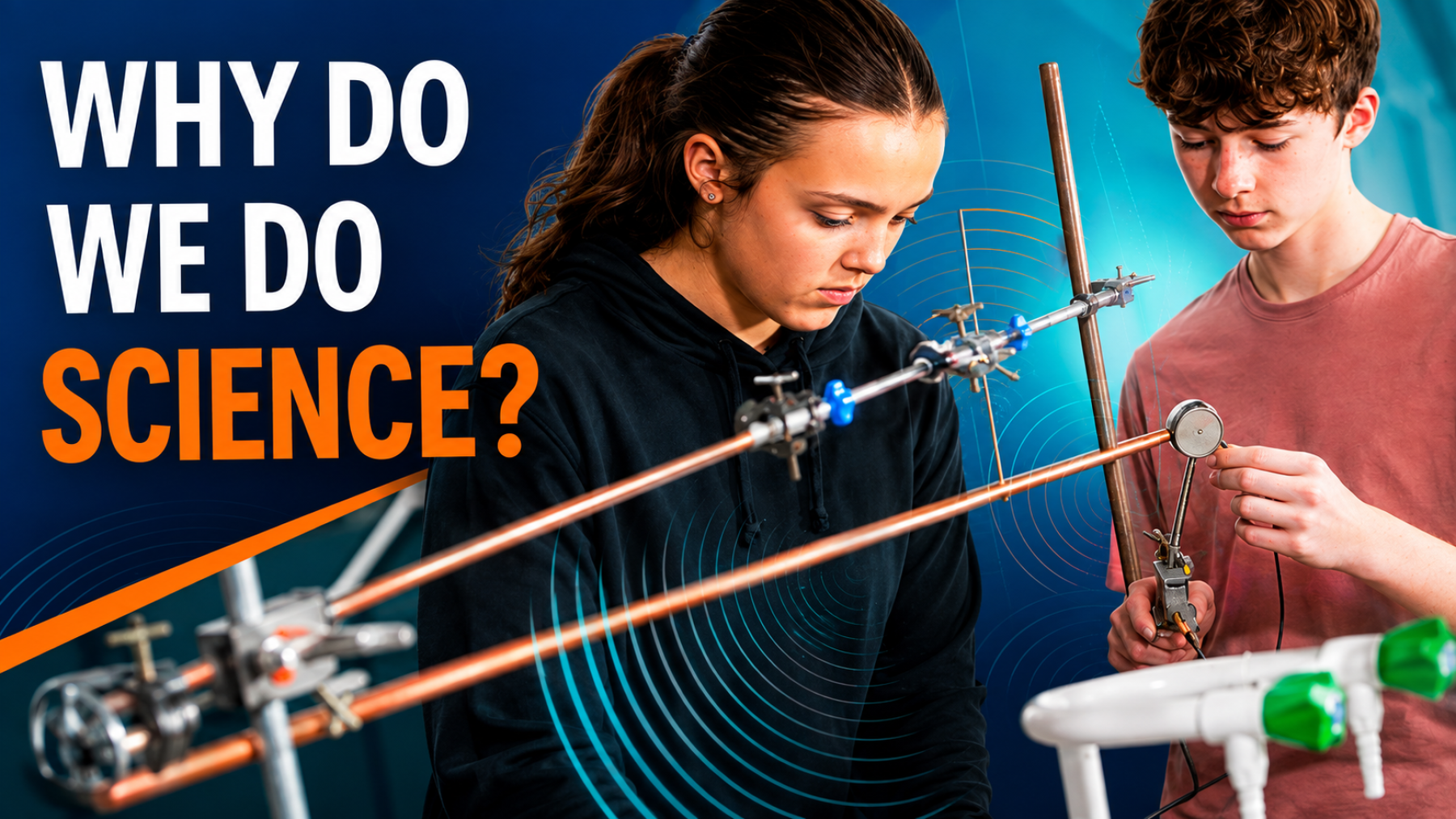
A student taps a metal rod. Two microphones detect the vibration at slightly different moments. From those measurements, the class can work out how quickly sound has travelled through the material.
That simple investigation shows why we do science. Rather than relying only on what we think should happen, we ask a question, collect evidence and use the results to test our ideas.
Science turns curiosity into knowledge
People have always been curious about the natural world. For much of history, explanations were often based on tradition, authority or speculation. Science introduced a more dependable approach: ideas should be observed, tested and open to challenge.
This does not mean science always gives us a final or perfect answer. It gives us a systematic way to discover when an idea may be wrong, improve our explanations and become more confident in what the evidence shows.
The scientific method is a process, not a rigid recipe
Scientific investigations do not all follow exactly the same steps, but they usually include the following stages:
- Curiosity and a question: notice something interesting and decide what you want to find out.
- Hypothesis: suggest a possible explanation based on existing knowledge.
- Prediction: state what you expect to observe if the hypothesis is useful.
- Test: plan an investigation that produces relevant measurements.
- Evidence: collect observations and data carefully.
- Analysis: look for patterns, relationships, variation and unexpected results.
- Conclusion and challenge: decide whether the evidence supports the prediction and consider other explanations.
- New question: use what you have learnt to decide what should be investigated next.
In practice, scientists often move backwards and forwards between these stages. A surprising result may lead to a revised hypothesis, a better method or a completely new question.
Learning objectives
By exploring why we use the scientific method, students can learn to:
- explain how science turns questions into testable ideas;
- distinguish between a hypothesis, a prediction, evidence and a conclusion;
- understand why repeat measurements and reproducible methods matter;
- recognise that variation and uncertainty are part of real data;
- use graphs and measurements to test an explanation;
- evaluate evidence and suggest useful improvements or further questions.
What makes the scientific method so useful?
- It makes ideas testable. Instead of simply saying, “I think this is true”, we ask what evidence would support or contradict the idea.
- It makes knowledge reproducible. Other people can repeat an investigation and check whether they obtain similar results.
- It helps separate a real pattern from random variation. Repeated measurements make it easier to judge whether a change is meaningful or simply part of normal measurement variation.
- It exposes bias. Clear methods, recorded evidence and scrutiny allow other people to question the choices we made and the conclusions we reached.
- It helps us describe uncertainty. Evidence does not always lead to a simple yes or no. Sometimes the most accurate conclusion is that the results suggest an explanation with a particular level of confidence.
- It allows us to make predictions. A useful scientific model should help us predict what will happen under new conditions.
- It allows knowledge to build over time. Further investigations can confirm, refine or overturn an earlier explanation.
A classroom example: measuring the speed of sound
A speed-of-sound investigation provides a clear example of the scientific process. Students might begin by asking whether sound travels at the same speed through air and through a solid.
The Wireless Speed Of Sound Pack can measure the speed of sound in gases and solids. Its microphone pair captures the signal, while EasySense gives students access to the measurements and graphs needed for analysis.
Equipment for an investigation will depend on the chosen material and method, but may include:
- the Wireless Speed Of Sound Pack (1270PK);
- a suitable measured path through air or a solid sample;
- clamp stands and measuring equipment appropriate to the activity;
- a computer, tablet or phone running EasySense;
- the sound source specified in the selected practical method.
The investigation can then follow the same scientific cycle:
- Form a hypothesis about how the medium may affect the speed of sound.
- Write a prediction that can be compared with measurements.
- Choose what will be changed, measured and kept the same.
- Collect data over a known distance and repeat the measurement.
- Use EasySense to inspect the signals, record results and compare trials.
- Look for variation, anomalies and evidence that supports or challenges the prediction.
- Reach a conclusion that matches the strength of the evidence.
- Suggest a new question, such as whether temperature or material choice changes the result.
Interpreting data, not chasing the “right” answer
Real measurements vary. That does not automatically mean an investigation has failed. The useful questions are whether the variation is small enough to reveal a pattern, whether an unusual result can be explained and whether another group could reproduce the method.
Graphs make this easier to discuss. Students can compare repeated trials, inspect the timing of recorded signals and decide whether their conclusion is supported by the whole set of evidence rather than one convenient value.
This is also where uncertainty becomes important. A conclusion should not claim more than the measurements can show. Careful scientific language such as “the evidence suggests” is often more accurate than presenting a result as absolute certainty.
Why science matters outside the laboratory
The same evidence-led approach supports decisions in many areas of life:
- Medicine: testing whether treatments work and identifying possible side effects.
- Engineering: checking designs before people rely on them.
- Technology: developing, testing and improving new systems.
- Environmental science: measuring changes in ecosystems and climate.
- Public policy: estimating the likely effects of a proposed change.
- Everyday decisions: distinguishing reliable evidence from anecdotes or assumptions.
The principle is the same in every case: decisions improve when ideas are tested against reality.
Science improves when ideas are challenged
One of science’s greatest strengths is that it allows us to change our minds. A scientific conclusion is better understood as the best explanation supported by the evidence currently available, not a truth that can never be questioned.
Better measurements may lead us to reconsider a conclusion. If an investigation cannot be reproduced, we ask why. If a model makes poor predictions, it can be improved or replaced. Science is self-correcting because evidence matters more than preserving an old idea.
Questions to explore next
- Does sound travel at the same speed through air and through a solid?
- How does changing the solid material affect the result?
- How do distance and measurement technique affect precision?
- What do repeated readings reveal about uncertainty?
- Can another group reproduce the result using the same method?
From curiosity to better questions
We do science because the world is complicated, our intuition can be wrong and curiosity alone is not enough. The scientific method helps us turn questions into evidence, evidence into explanations and explanations into useful predictions.
It does not promise certainty. It gives us something more practical: a dependable way to test ideas, learn from mistakes and become less wrong.
Download the full activity
The full worksheet introduces the scientific method, explores its wider benefits and provides a clear framework for discussing evidence, uncertainty, prediction and scientific progress.
Find and download the worksheet in Practical Explorer