Published: Aug-2026 | Category: Secondary Science
Have you ever looked at a scientific constants sheet and wondered why it contains so many numbers?
At first glance, values such as the speed of light, Avogadro’s constant and the mass of an electron can seem like little more than figures to insert into equations. However, scientific constants are far more important than that. They help us measure, compare and explain the natural world.
From the behaviour of atoms to the movement of planets, constants provide a shared foundation for mathematics, physics, chemistry, biology and astronomy.
A scientific constant is a quantity with a fixed or internationally agreed value. Scientists can use these values in calculations and experiments knowing that other researchers are working from the same reference points.
Some constants, including the speed of light, have exact values within the International System of Units. Others are experimentally measured quantities, while values such as standard gravity provide agreed reference conditions for calculations.
Our Scientific Constants reference sheet brings together commonly used values from across the sciences, making it a useful resource for lessons, practical investigations and independent study.
Imagine trying to build a house if every architect and engineer used a different definition of a metre. Now imagine scientists using different values for the speed of light, the charge of an electron or the number of particles in a mole.
Research results would be difficult to compare, engineering calculations would become unreliable and many of the technologies we depend on would not work correctly.
Scientific constants give researchers, engineers, teachers and students a common language. A calculation carried out in a school laboratory can therefore be based on the same scientific principles as research taking place in a university, hospital or spacecraft.
The most interesting thing about a scientific constant is not simply its numerical value. It is what that value tells us about the universe.
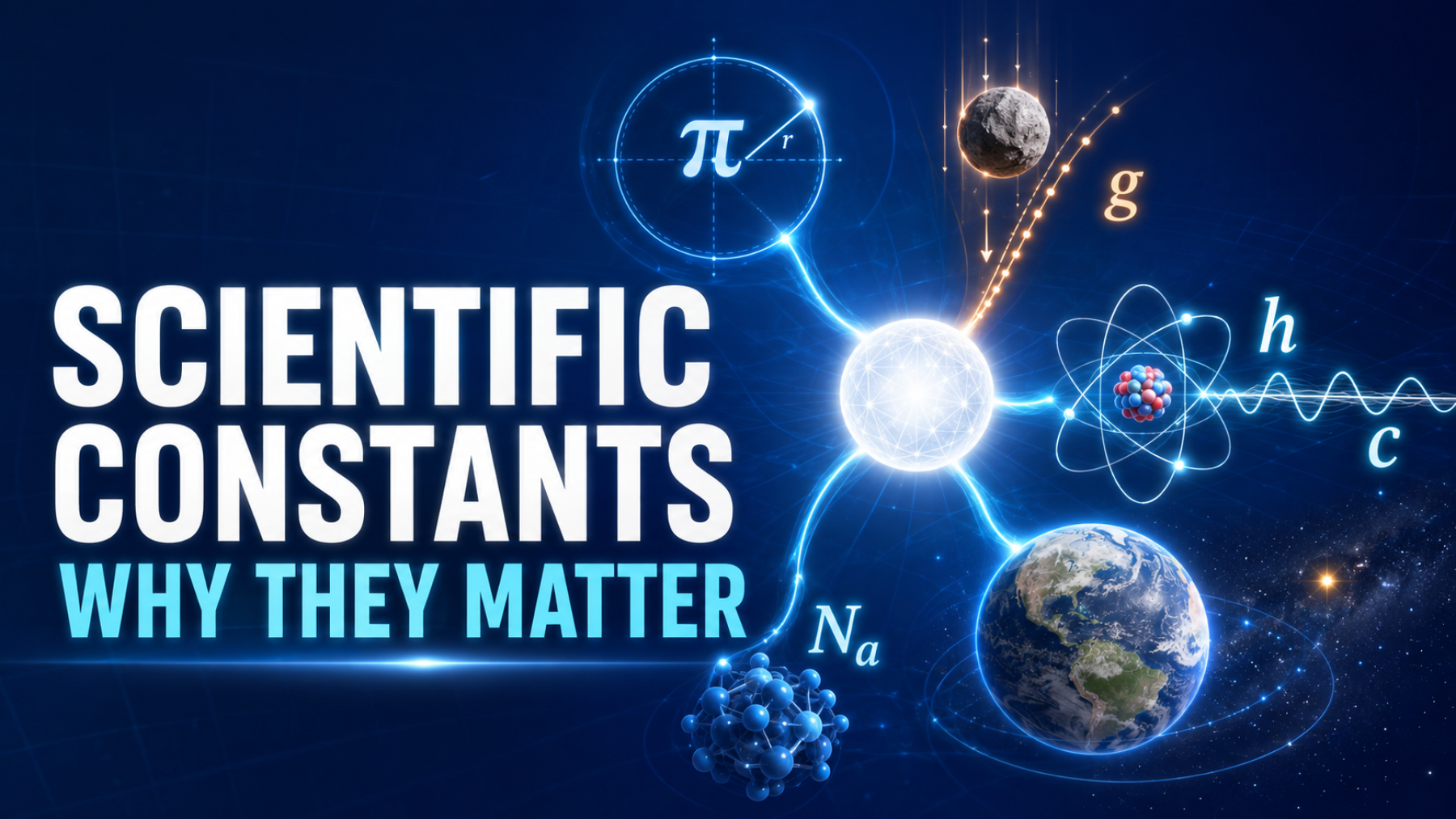
Pi, written as π, is approximately 3.14159. It represents the relationship between the circumference of a circle and its diameter. This relationship remains the same regardless of whether the circle is found in a tiny machine component, a wheel or the orbit of a planet.
Standard acceleration due to gravity is approximately 9.80665 m s-2. It provides a reference value for calculations involving falling objects, projectiles, pendulums and forces.
Local gravity varies slightly depending on altitude, latitude and geology, but the standard value allows scientists to make consistent comparisons.
The speed of light in a vacuum is exactly 299,792,458 m s-1. This is not simply a very large number; it represents a fundamental speed limit in our universe.
It also plays an important role in communications, astronomy, satellite navigation and our understanding of space and time.
Avogadro’s constant is 6.02214076 × 10²³ mol-1. It allows chemists to connect the microscopic world of atoms and molecules with quantities that can be measured in a laboratory.
Rather than attempting to count individual particles, scientists can work with moles and use Avogadro’s constant to calculate how many particles are present.
Planck’s constant is 6.62607015 × 10⁻³⁴ J s. It helps describe how energy behaves at atomic and subatomic scales and is one of the foundations of quantum physics.
Its extremely small value reflects the tiny energy changes involved when studying particles, atoms and light.
School subjects are often taught separately, but the natural world does not divide itself into individual lessons. Scientific constants help demonstrate how closely connected the different branches of science really are.
| Area of science | Example | What it helps us understand |
|---|---|---|
| Mathematics | Pi (π) | Circles, waves, rotations and periodic motion |
| Mechanics | Standard gravity (g) | Falling objects, forces and motion |
| Electromagnetism | Speed of light (c) | Light, radio waves and communications |
| Quantum physics | Planck’s constant (h) | Energy at atomic and subatomic scales |
| Chemistry | Avogadro’s constant (NA) | The number of particles in a mole |
| Thermodynamics | Boltzmann constant (kB) | The relationship between temperature and particle energy |
| Astronomy | Astronomical unit (AU) | Distances within our Solar System |
The mathematics used to describe a chemical reaction can also be used to model planetary motion. Electromagnetism makes medical imaging and wireless communication possible, while chemistry helps explain the biological processes taking place inside living cells.
A scientific constants sheet is therefore more than a collection of separate facts. It shows how different scientific disciplines fit together.
The reference sheet also includes useful biological quantities such as the number of human chromosomes, the diameter of the DNA double helix and physiological pH.
These are slightly different from fundamental physical constants. Biological values can represent typical measurements, agreed reference points or features shared by a particular group of organisms.
For example, 37 °C is commonly used as a reference for normal human body temperature, but an individual’s temperature naturally varies throughout the day and between different parts of the body. Similarly, physiological pH is often quoted as approximately 7.4, although pH differs between blood, stomach contents and other parts of the body.
This distinction provides an excellent opportunity to discuss uncertainty, variation and the importance of understanding the context behind a number.
Scientific constants are not only needed for lessons and examinations. They support many of the technologies and services we use every day.
Modern technology works because scientists and engineers can depend on consistent measurements and agreed definitions.
Students do not necessarily need to memorise every number on a scientific constants sheet. What matters most is being able to recognise the relevant constant, understand what it represents and use it correctly.
When using a constant, students should ask:
Units are especially important. A number without its unit can lose much of its meaning, and using incompatible units is a common source of errors in scientific calculations.
Give students the Scientific Constants reference sheet and ask each group to choose one value from a different area of science.
They can then investigate:
Students could present their findings as a poster, short video or classroom explanation. This transforms the sheet from a list of numbers into a collection of scientific stories.
A scientific constants sheet represents centuries of observation, experimentation and international collaboration. Each value helps us describe part of the natural world, from the structure of DNA to the distances between stars.
The next time you reach for a constants or formula sheet, take a moment to look beyond the calculation. Every value represents an idea that has helped shape our understanding of the universe - and that is far more interesting than simply memorising a number.
Keep essential values from mathematics, physics, chemistry, biology and astronomy close at hand with our free Scientific Constants reference sheet.
Take a look at the following articles from the same topic.