Published: Jul-2026 | Category: Fun With Science
Understanding how light behaves when it passes between different materials is one of the foundations of physics. From prescription glasses and camera lenses to fibre optic broadband and medical imaging, refractive index plays a vital role in modern technology.
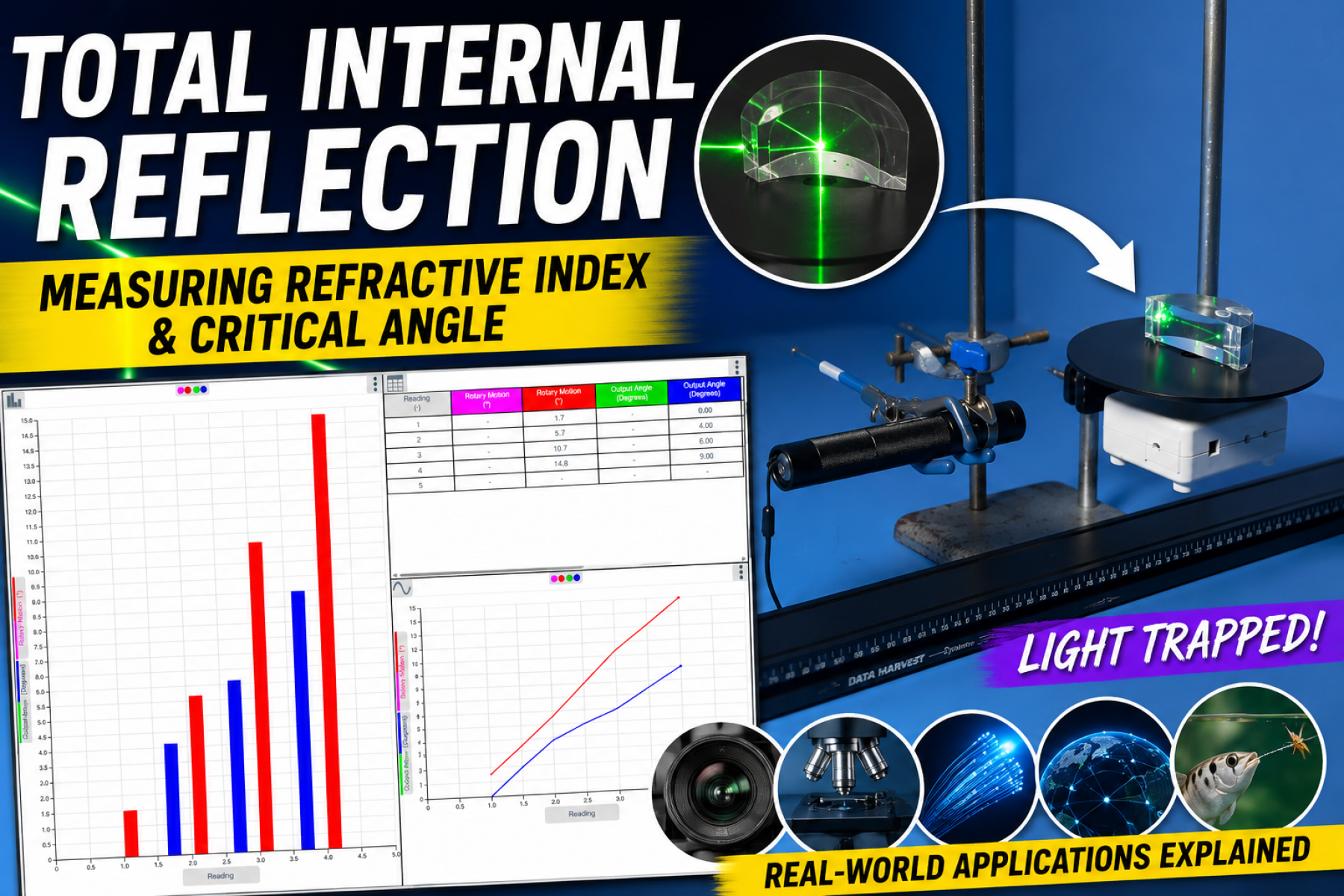
In this practical investigation, students measure the critical angle for total internal reflection (TIR) using the Wireless Rotary Motion Sensor, before calculating the refractive index of an acrylic block.
Watch the Total Internal Reflection experiment on YouTube
When light travels from one material into another, its speed changes. This change in speed causes the light to bend, a phenomenon known as refraction.
When light travels from a material with a higher refractive index, such as acrylic or glass, into a material with a lower refractive index, such as air, the refracted ray bends away from the normal.
As the angle of incidence increases, the refracted ray eventually reaches an angle of 90°. This point is known as the critical angle.
If the angle of incidence becomes larger than the critical angle, the light no longer leaves the material. Instead, it is reflected entirely back inside. This is called Total Internal Reflection.
Total internal reflection is not just a classroom demonstration. It is the physics behind some of the most important technologies used today, including:
This investigation allows students to:
The experiment begins by aligning a laser beam with the centre of a semi-circular acrylic block mounted on the Wireless Rotary Motion Sensor.
As the block is slowly rotated, the angle of incidence increases while the laser continues to enter the curved surface normally. This helps reduce unwanted refraction at the entry point, ensuring the measurement focuses on what happens at the flat face of the block.
Students observe the emerging beam as the angle increases. Eventually, the refracted beam skims along the surface before disappearing completely. This marks the critical angle.
The angle is recorded using the Wireless Rotary Motion Sensor and repeated several times to improve reliability.
Using the measured critical angle, students calculate the refractive index using:
n = 1 / sin(c)
where:
The semi-circular acrylic block is an important part of the setup.
Because the laser enters through the curved surface, it can be arranged to strike the surface at normal incidence. This means little or no refraction occurs as the light enters the block.
As a result, students can focus on the behaviour of the light at the flat surface, making the critical angle easier to identify and improving the quality of the results.
The Wireless Rotary Motion Sensor works with EasySense software, allowing students to:
This gives students experience of collecting high-quality experimental data while reinforcing important data-handling skills.
Although this experiment is performed with a laser and acrylic block, the same physics is used every day around the world.
Total internal reflection allows internet data to travel through fibre optic cables, helps doctors see inside the human body using endoscopes, and enables optical instruments to transmit light efficiently with minimal loss.
Even nature provides examples of refraction in action. The Archerfish compensates for the bending of light at the water's surface, allowing it to accurately target insects above the water.
This Total Internal Reflection practical is available as part of Data Harvest's growing Practical Explorer collection of free science investigations.
Explore Practical Explorer and download the free worksheet
The Wireless Rotary Motion Sensor provides precise angular measurements for a wide range of Physics investigations, including:
Its wireless connectivity and seamless integration with EasySense make it an ideal tool for practical science lessons.
Take a look at the following articles from the same topic.